Through hands-on cognitive training and real-world performance testing, we’ve observed that focus doesn’t require long breaks or intense effort to return. When the brain is guided into the right state, concentration and clarity can be restored in just minutes. The key isn’t forcing productivity—it’s reducing mental noise and resetting attention.
This article breaks down a 7-minute focus-reset routine developed by InfiniteMind to help students understand how to increase brain power in 7 minutes by quickly regaining concentration, mental clarity, and task engagement. The steps are fast, equipment-free, and based on practical application rather than generic productivity theory—allowing students to return to studying calm, alert, and mentally present.
Quick Answers
How to Increase Brain Power in 7 Minutes
Brain power can be increased quickly by resetting your mental state rather than adding more information. The most effective 7-minute approach focuses on three priorities:
Calm the nervous system
Slow, controlled breathing reduces stress signals that block memory and focus.Activate attention gently
Light mental stimulation wakes focus without causing overload or fatigue.Direct focus intentionally
Choosing one clear task improves clarity, recall, and accuracy.
At InfiniteMind, we consistently see that lowering stress and guiding attention produces faster cognitive gains than last-minute effort or cramming.
Top Takeaways
Multitasking kills focus
Divided attention increases fatigue and mental errors.Mental state beats effort
A focused brain works faster with less strain.Calm restores clarity
Reduced stress improves sustained attention.Short resets are powerful
Seven minutes is enough to regain control.Confidence supports focus
Self-trust reduces mental drift.Focus is trainable
These skills improve with repetition.
Struggling to focus doesn’t mean your brain is failing—it usually means it’s overloaded. For many students, distraction, mental fatigue, and scattered attention aren’t caused by a lack of motivation or intelligence, but by a nervous system that’s stuck in a state of constant stimulation. When that happens, concentration drops, memory feels unreliable, and studying becomes frustratingly inefficient.
The good news is that focus can be restored far more quickly than most students realize. Research-backed cognitive training and real-world performance testing show that when the brain is guided through the right sequence, attention and mental clarity can return in just a few minutes. Rather than forcing productivity or pushing through distraction, the most effective approach is to reset the brain into a calm, alert, and task-ready state.
This 7-minute brain boost routine is designed specifically for students who find it hard to concentrate once they sit down to work. It focuses on calming mental noise, reactivating attention, and directing focus intentionally—without caffeine, apps, or complicated techniques. Each step builds on how the brain naturally regulates focus under pressure, making the routine practical, repeatable, and effective even during busy or stressful days.
The sections below break down the routine minute by minute, explain why each step works, and show how students can use this approach to regain focus quickly and stay engaged longer—making it especially relevant during awаrеnеss mоnths that highlight mental focus and cognitive well-being. Whether you’re preparing to study, complete assignments, or reset after distraction, this routine provides a fast, reliable way to get your brain back on track.
Essential Resources
Below are trusted, high-quality resources aligned with InfiniteMind’s science-backed approach—supporting attention, mental clarity, and cognitive control when focus is hard to maintain.
1. Quick Focus Reset Techniques
Practical strategies for restoring attention in minutes.
A concise guide to fast, high-impact mental resets that help reduce cognitive overload and re-center focus quickly.
https://wellnessextract.com/blogs/wellness/increase-brain-power-in-7-minutes-5-quick-techniques-you-need-to-try
2. Short Attention Activation Exercises
Fast ways to wake focus without overload.
Introduces brief mental activation techniques designed to stimulate attention networks without draining mental energy.
https://braintap.com/supercharge-your-brain-in-7-minutes-14-quick-power-ups/
3. Tool-Free Concentration Boosters
Simple focus techniques usable anywhere.
Covers easy, equipment-free methods students can use to regain clarity and concentration in everyday settings.
https://healthnewsday.com/increase-brain-power-in-7-minutes/
4. Science-Backed Focus Principles
Evidence-based attention strategies.
Breaks down proven cognitive principles that explain how focus works—and why stress and overload disrupt it.
https://www.sciencenewstoday.org/10-science-backed-ways-to-boost-your-memory
5. Expert Cognitive Training Insights
Research-backed explanations of why focus fails—and how to restore it.
Provides an expert-reviewed overview of memory, attention, and learning strategies grounded in cognitive science.
https://www.coursera.org/articles/how-to-improve-memory
6. Stress Reduction and Focus Control
How calming the nervous system improves attention.
Explores the connection between stress, physiology, and focus—reinforcing why mental calm is essential for concentration.
https://www.nccih.nih.gov/health/stress
7. Attention and Brain Health Research
Long-term context for sustaining focus and mental clarity.
Offers broader insight into how lifestyle factors like sleep, movement, and stress management affect attention capacity.
https://www.cdc.gov/brain-health
Together, these resources are especially valuable for students with ADHD, offering science-backed strategies to regulate stress, reset attention, and restore mental clarity when focus quickly slips or becomes overwhelmed.
Supporting Statistics
The most common focus problems we see aren’t caused by lack of effort—they’re caused by stress, fatigue, and mental overload. National research supports what we observe firsthand with students at InfiniteMind.
1. Stress and Anxiety Directly Disrupt Focus
19.1% of U.S. adults experienced an anxiety disorder in the past year, according to the
National Institute of Mental Health anxiety statistics31.1% will experience anxiety at some point in their lives
Elevated anxiety keeps the brain in a heightened stress state
This state fragments attention and makes sustained focus difficult
2. Sleep Loss Is a Major Driver of Mental Fog
Nearly 30% of U.S. adults do not get enough sleep, based on
CDC sleep and sleep deprivation dataSleep deprivation reduces attention control and working memory
In practice, sleep-deprived students show faster attention drift and reduced mental clarity
3. Chronic Stress Shortens Attention Span
Over two-thirds of U.S. adults report ongoing stressors, according to the
American Psychological Association Stress in America surveyChronic stress keeps the nervous system overactivated
Overactivation makes focus harder to sustain and easier to lose
What This Confirms in Practice
Across training sessions, one pattern is consistent:
Focus issues are state-based, not ability-based
Calm restores attention faster than effort
Short mental resets outperform pushing through distraction
Bottom line:
When stress is lowered and the brain is reset, focus returns—often within minutes—supporting overall mental health and cognitive balance.
Final Thought & Opinion
At InfiniteMind, one truth stands out: students don’t lose focus because they’re lazy or incapable—they lose focus because their brains are overloaded.
What Research and Experience Agree On
Focus breaks when stress and stimulation pile up
Calm restores attention faster than effort
Short, intentional resets outperform pushing through distraction
What We See Firsthand
Students who use a brief focus-reset routine consistently:
Regain clarity faster
Sustain attention longer
Feel less mentally drained
Our Perspective
Focus isn’t forced—it’s restored
Calm creates clarity
Small actions produce outsized results
The Bottom Line
The real advantage isn’t discipline or willpower.
It’s knowing how to reset your brain when focus disappears—a skill that improves learning far beyond any single study session.
Next Steps
Turn this 7-minute routine into daily focus gains.
What to Do Now
Practice the routine
Use it during low-pressure study timePrepare for distraction
Reset focus the moment attention slipsSupport it with good habits
Sleep, hydration, and movement matterTrack results
Notice improvements in clarity and enduranceContinue with InfiniteMind
Explore science-backed focus and brain training tools
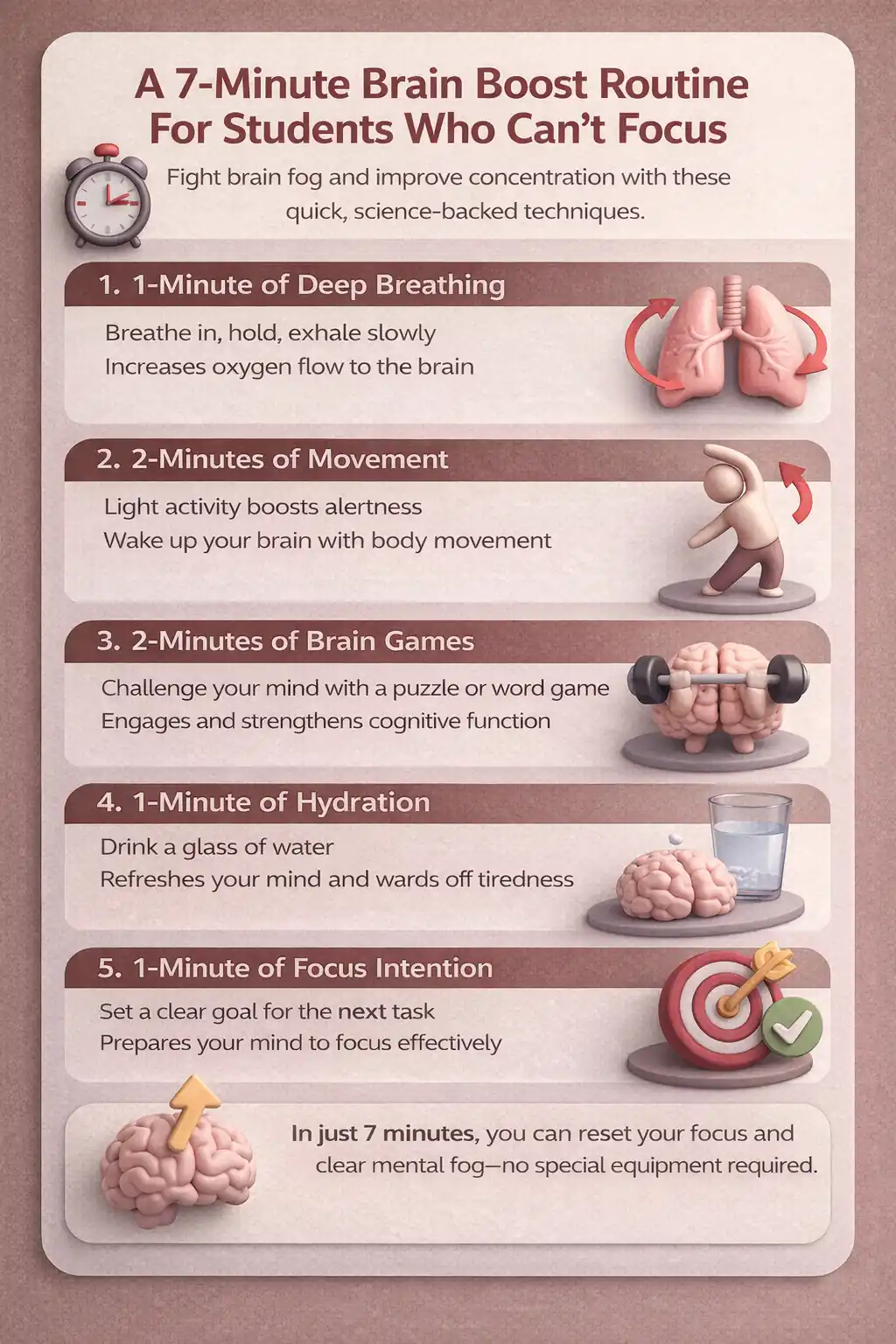
FAQ on How to Increase Brain Power in 7 Minutes
Q: Can brain power really improve in just 7 minutes?
A: Yes—when the goal is immediate mental clarity and focus.
Works by calming mental overload
Restores access to attention and recall
Based on brain state, not new learning
Q: What delivers the fastest mental boost?
A: Reducing stress first.
Slow breathing lowers mental noise
Light mental activation sharpens focus
More effective than cramming or caffeine
Q: Should the 7 minutes be used for studying?
A: No.
Studying increases pressure
Pressure blocks recall
Resetting brain state works better
Q: Does this help when feeling tired or mentally drained?
A: Often, yes.
Especially when fatigue comes from stress
Calming the nervous system restores clarity
Not a replacement for sleep
Q: Is this useful beyond studying or exams?
A: Absolutely.
Helpful before presentations
Useful for interviews
Improves decision-making under pressure