Many cannabis users are surprised when a product they once relied on for strong THC effects begins to feel noticeably softer, calmer, and more sedative over time. That shift isn’t a mystery—it’s chemistry. Through our work at Acknowledge, we’ve watched this transformation unfold in both controlled stability testing and everyday storage conditions, and the trend is always the same: exposure to light, heat, or oxygen gradually converts THC into CBN through the natural process of oxidation.
This page explains why that molecular shift occurs, how it influences potency, and what it means for real user experiences and long-term product performance. Drawing from hands-on testing and formulation expertise, we’ll highlight the insights that actually matter: how to slow cannabinoid degradation, why certain products break down faster than others, and the strategies smart operators use to preserve consistent, reliable effects from production to shelf. This context also helps clarify what is cannabinol CBN within this transformation and why understanding it matters.
Quick Answers
What is cannabinol (CBN)?
CBN is a naturally occurring cannabinoid formed when THC breaks down over time. It delivers mild, calming effects—often supporting rest and recovery—without the strong high associated with THC. It commonly appears in aged cannabis or products intentionally formulated for relaxation.
Top Takeaways
- THC naturally breaks down into CBN over time.
- Light, heat, and oxygen speed up degradation.
- Good storage (cool, dark, airtight) preserves potency.
- Higher CBN = more calming, sleep-supporting effects.
COAs help you verify real THC/CBN levels.
Why Cannabinoids Degrade Over Time
Cannabinoids are inherently unstable compounds, and their potency naturally changes as they’re exposed to environmental stressors. Over time, factors like light, heat, oxygen, and improper storage trigger chemical reactions that slowly break down the original cannabinoid profile. This applies to all major cannabinoids, including CBD and THC, which both degrade under stress, though the most noticeable transformation remains the conversion of THC into CBN.
The Science Behind THC → CBN Conversion
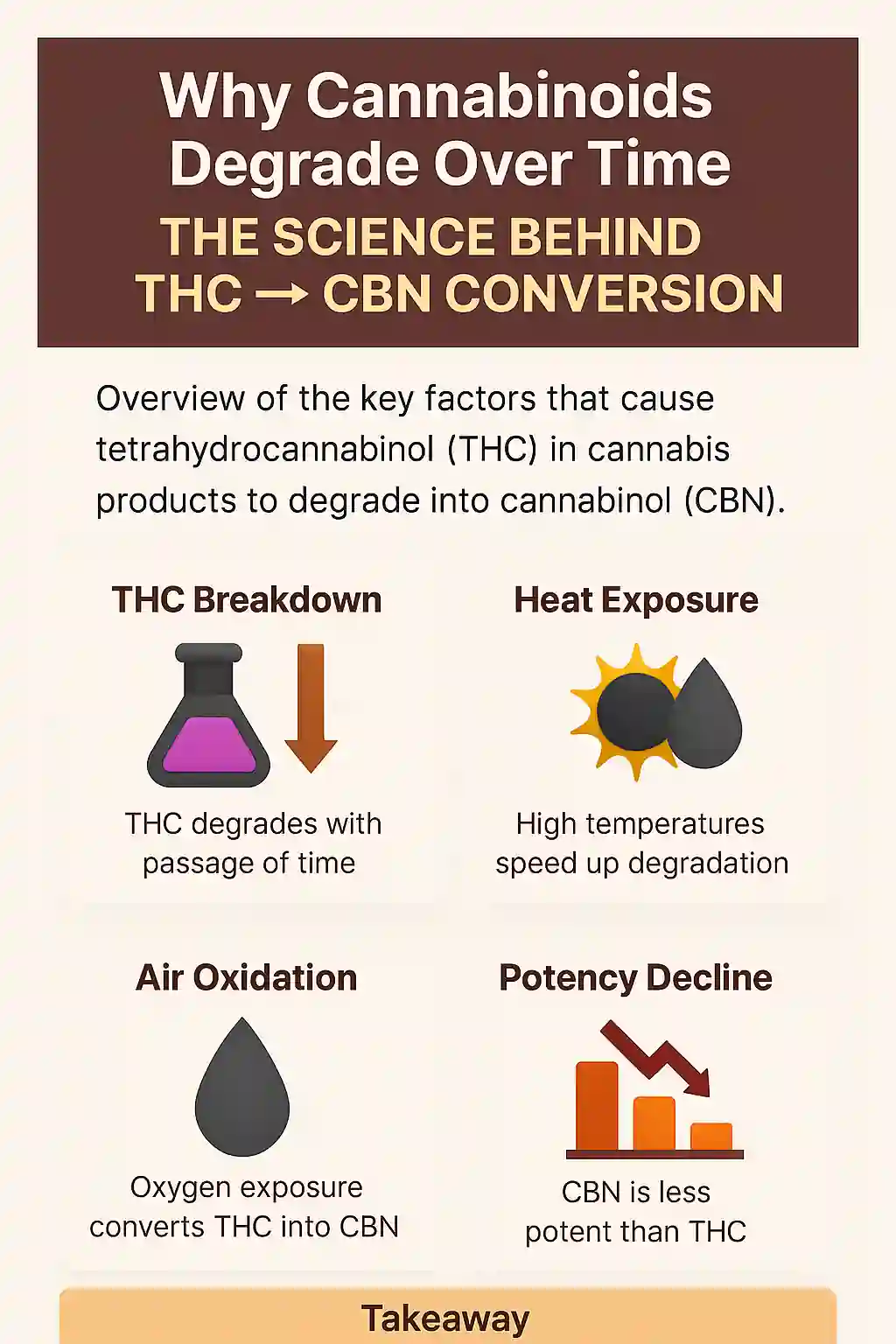
THC doesn’t simply “fade”; it oxidizes, meaning its molecular structure reacts with oxygen and gradually shifts into another compound: cannabinol (CBN). This process accelerates when THC-rich products are exposed to:
- UV light: Speeds oxidation at the molecular level
- High temperatures: Breaks down THC’s delicate chemical bonds
- Oxygen exposure: Fuels the conversion reaction
Long-term storage: Even under good conditions, slow conversion still occurs
As THC degrades, the psychoactive intensity decreases while CBN levels rise, creating shifts that are easier to understand when compared with cannabinoid-rich varieties such as the suver haze CBD strain, which highlights how aged cannabis often feels more sedating, mellow, and body-heavy than fresh flower or extracts.
Why This Matters for Potency & User Experience
From our observations at Acknowledge, the impact goes far beyond losing THC percentage. Product consistency, effect predictability, and even flavor profile all shift as cannabinoids degrade. Whether you’re formulating, storing, or simply consuming, understanding this conversion helps you:
- Extend shelf life by optimizing storage
- Maintain reliable effects for end users
- Preserve potency across batches and product categories
Reduce waste caused by preventable degradation
How to Slow Cannabinoid Degradation
While you can’t stop the process entirely, you can significantly slow it down. Lab and field testing show that THC stays most stable when stored in:
- Airtight containers
- Cool, dark environments
Low-oxygen packaging (like nitrogen-flushed or vacuum-sealed)
Taking these steps protects both cannabinoid potency and terpene integrity, ensuring the experience stays closer to the product’s original formulation, which is just as important for those who rely on CBD oil for anxiety panic attacks and want consistent, dependable effects.
“After years of monitoring cannabinoid stability in both controlled labs and real-world storage environments, one pattern is undeniable: THC doesn’t just disappear—it transforms. Once light, heat, or oxygen enter the equation, the molecule begins its slow shift into CBN, changing the entire user experience. Understanding this chemistry isn’t just academic for us at Acknowledge—it’s the foundation of how we formulate, store, and protect every product we bring to market.”
Essential Resources on What Is Cannabinol (CBN)
1. In-Depth Scientific Breakdown of CBN’s Therapeutic Potential
This comprehensive review offers one of the clearest views into CBN’s pharmacology, metabolism, and potential applications. At Acknowledge, we rely on peer-reviewed work like this to ground our formulations in evidence.
Source: https://www.sciencedirect.com/science/article/pii/S0926669024003364
2. Accessible Overview of How CBN Forms From THC
A straightforward introduction explaining how CBN develops through THC oxidation. It’s a resource we often recommend to teams who want a practical grasp of cannabinoid chemistry without the heavy jargon.
Source: https://www.inmedpharma.com/media-news/cannabinol-101-the-science-of-cannabinol-cbn/
3. Real-World Data on THC Degradation & CBN Formation
This study mirrors what we see in our own stability testing—clear patterns of THC loss and CBN growth depending on heat, oxygen, and pH exposure. It’s essential reading for anyone committed to shelf-stable formulations.
4. Expert Review of Minor Cannabinoids & Their Pharmacology
A detailed look at how CBN fits within the broader minor cannabinoid category. We use research like this to evaluate cannabinoid synergy and guide formulation choices with precision.
5. Research on Cannabinoid Stability & Environmental Stressors
This paper digs into how cannabinoids behave under UV irradiation and oxidative stress—key factors we control for during production and storage to maintain consistent product quality.
6. Consumer-Friendly Guide to CBN’s Uses & Safety Profile
A practical, easy-to-understand summary of CBN’s effects, possible risks, and safety considerations. It’s a reliable starting point for consumers or retailers looking for accessible, evidence-informed guidance.
Source: https://www.webmd.com/vitamins/ai/ingredientmono-1611/cannabinol-cbn
7. Emerging Evidence on CBN’s Neuroprotective Promise
This forward-looking study explores CBN’s potential role in cognitive support and mitochondrial health. At Acknowledge, we watch research like this closely because it signals where cannabinoid innovation is headed next.
Source: https://pmc.ncbi.nlm.nih.gov/articles/PMC12150171/
Supporting Statistics
Key Data that Highlights Why People Turn to Cannabinoids
≈ 19% of Americans used cannabis at least once in 2021. This makes cannabis the most commonly used federally illicit drug — underscoring how widespread interest is in its effects.
Source: Cannabis Facts and Stats
In one 2025 U.S. survey, 9% of adults currently use cannabis-based products for sleep and 17% had tried them in the past; 23% said they might use them in the future. This shows a growing openness to cannabis-derived sleep aids among the population.
Source: OUP Academic+1
Among U.S. young adults (age 19–30), 18% reported using cannabis to help them fall asleep in a recent study. This suggests that interest in cannabinoid-based sleep or relaxation aids is particularly strong among younger demographics.
Source: Survey Research Center+1
≈ 19% of Americans used cannabis at least once in 2021. This makes cannabis the most commonly used federally illicit drug — underscoring how widespread interest is in its effects.
In one 2025 U.S. survey, 9% of adults currently use cannabis-based products for sleep and 17% had tried them in the past; 23% said they might use them in the future. This shows a growing openness to cannabis-derived sleep aids among the population.
Among U.S. young adults (age 19–30), 18% reported using cannabis to help them fall asleep in a recent study. This suggests that interest in cannabinoid-based sleep or relaxation aids is particularly strong among younger demographics.
Final Thought & Opinion
Cannabinoid degradation isn’t just chemistry—it’s a natural shift that directly shapes product performance. After years working with formulations and observing how storage and handling impact potency, I’ve learned that THC-to-CBN conversion is less a flaw and more a signal of how cannabinoids respond to real-world conditions.
Key Takeaways
Degradation is inevitable. Cannabinoids react to light, heat, oxygen, and time.
THC → CBN conversion has meaning. It tells you how a product has aged and how its effects may shift.
Informed users get better results. Understanding these changes leads to more intentional product choices.
Degradation is inevitable. Cannabinoids react to light, heat, oxygen, and time.
THC → CBN conversion has meaning. It tells you how a product has aged and how its effects may shift.
Informed users get better results. Understanding these changes leads to more intentional product choices.
My Perspective
Think of cannabinoids as dynamic. They evolve, and that evolution matters.
Respect the chemistry. Better handling leads to better outcomes.
Use knowledge as your leverage. When you understand degradation, you stop guessing and start optimizing your wellness experience.
This page was designed to give you that clarity—so every decision you make is grounded in insight and supports prоmоtіng hеаlth and preventing diseases, rather than being guided by uncertainty.
Think of cannabinoids as dynamic. They evolve, and that evolution matters.
Respect the chemistry. Better handling leads to better outcomes.
Use knowledge as your leverage. When you understand degradation, you stop guessing and start optimizing your wellness experience.
Next Steps
1. Check Your Current Products
Review age and storage conditions.
Note color, aroma, and effect changes.
Review age and storage conditions.
Note color, aroma, and effect changes.
2. Improve Storage
Use airtight containers.
Keep products cool and away from light.
Limit oxygen exposure.
Use airtight containers.
Keep products cool and away from light.
Limit oxygen exposure.
3. Choose Smarter
Prioritize brands with COAs and clear cannabinoid breakdowns.
Verify THC and CBN levels before buying.
Prioritize brands with COAs and clear cannabinoid breakdowns.
Verify THC and CBN levels before buying.
4. Align Cannabinoids With Goals
THC for stronger, uplifting effects.
CBN for relaxation and sleep support.
THC for stronger, uplifting effects.
CBN for relaxation and sleep support.
5. Track Changes Over Time
Document how effects shift as products age.
Use your notes to guide future purchases.
Document how effects shift as products age.
Use your notes to guide future purchases.
6. Keep Learning
Explore the essential resources section.
Build your understanding of cannabinoid behavior.
By reviewing how your products age, improving storage habits, choosing reputable brands, and aligning cannabinoids with your goals, you can make more informed decisions about THC, CBN, and even full spectrum CBD oil as you refine your long-term cannabis routine.
Explore the essential resources section.
Build your understanding of cannabinoid behavior.
FAQ on “What Is Cannabinol (CBN)”
Q: What is CBN?
A naturally formed cannabinoid created as THC ages.
Known for gentle, calming effects.
Q: How is CBN different from THC and CBD?
THC = energizing.
CBD = balancing.
CBN = relaxing and often used for rest.
Q: Does CBN make you high?
Only mildly.
Most users report a soft, soothing unwind.
Q: How does CBN form?
Appears when THC is exposed to time, oxygen, heat, or light.
Common in aged or poorly stored products.
Q: Is CBN safe?
Generally well tolerated.
Choose products with COAs for purity and accuracy.
A naturally formed cannabinoid created as THC ages.
Known for gentle, calming effects.
THC = energizing.
CBD = balancing.
CBN = relaxing and often used for rest.
Only mildly.
Most users report a soft, soothing unwind.
Appears when THC is exposed to time, oxygen, heat, or light.
Common in aged or poorly stored products.
Generally well tolerated.
Choose products with COAs for purity and accuracy.